
Engineering America's EV Charging Network: Site Work, Electrical Capacity, and Grid Upgrades
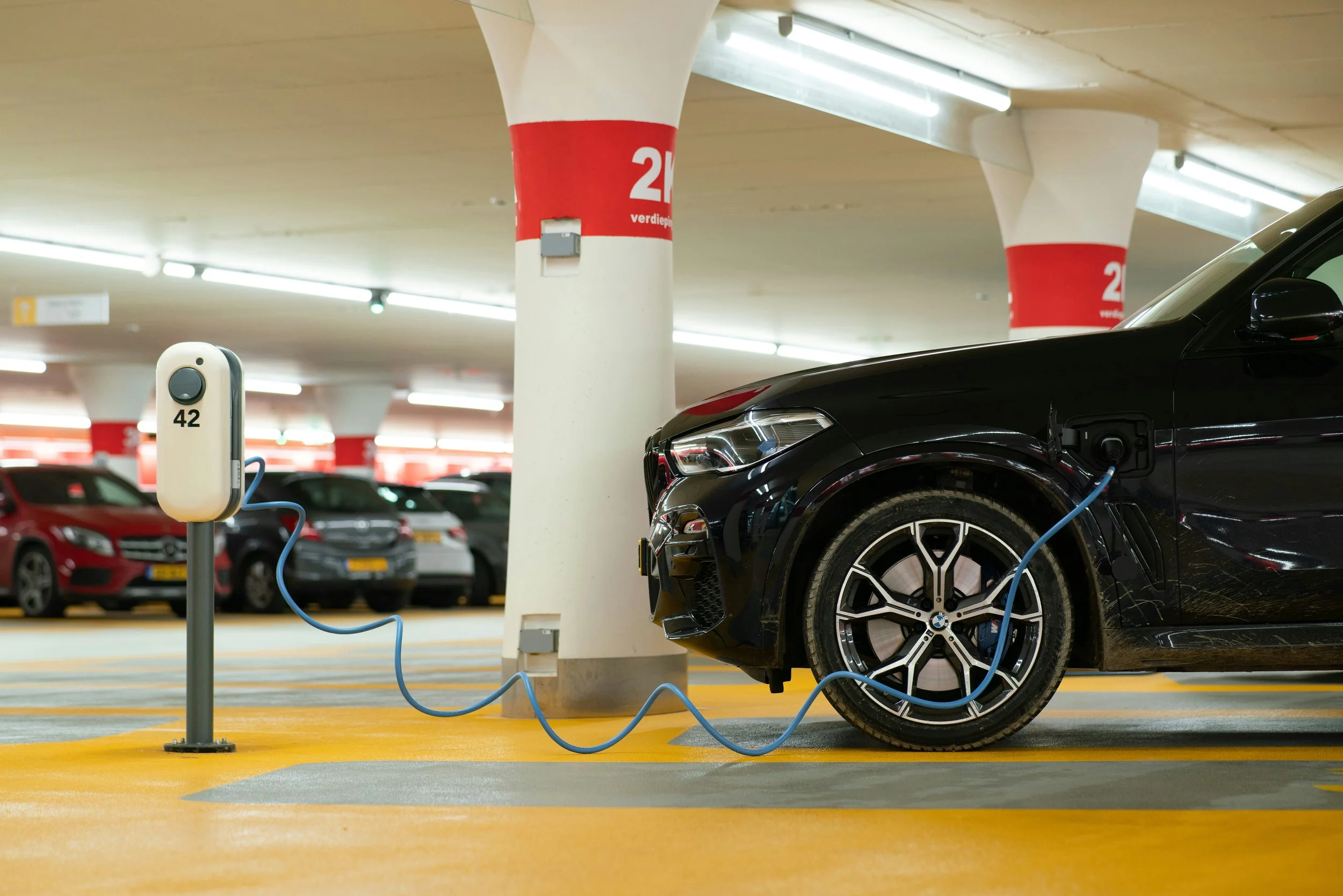
There's a massive infrastructure buildout happening across the country that doesn't get nearly as much engineering press as it deserves. Tens of thousands of electric vehicle charging stations are being designed, permitted, and constructed every year. Most of the public conversation around this buildout focuses on the policy side, how many chargers, which states, what funding program. The civil and electrical engineering side of the story is considerably less covered and considerably more interesting.
Building a charging station isn't like installing a parking meter. A DC fast charger delivering 150 to 350 kilowatts of power needs a transformer upgrade, a utility service entrance rated for that load, conduit runs from the electrical room to each charging pedestal, concrete equipment pads, adequate drainage, ADA-compliant layout, and in many locations a site design that handles the intersection of a busy EV station with existing traffic, parking, and pedestrian patterns. A fleet depot with 50 to 100 chargers requires electrical infrastructure that rivals a small industrial facility.
This post covers what the EV charging buildout actually involves from a civil and electrical engineering standpoint, where the real complexity lives, what the current state of the federal funding picture is, and what developers, site owners, and municipalities need to understand before they commit to a project.
1. The Scale of What's Being Built
California alone needs more than one million public and shared private chargers by 2030, rising to 2.1 million by 2035, to support projected electric vehicle adoption. That's according to the state's own infrastructure assessment under Assembly Bill 2127. Nationally, the federal government's NEVI program, the National Electric Vehicle Infrastructure Formula Program created by the IIJA, allocated $4.4 billion across all 50 states specifically to fund charging along highway corridors.
By the end of 2025, 42 states had approved their FY26 NEVI plans, and the number of operational highway charging stations funded through the program had doubled compared to the year before. More than 4,000 DC fast charging ports had been awarded under NEVI allocations. That sounds like progress, and it is, but a January 2026 report found that states had collectively spent only about 2 percent, or $94 million, of the full $4.4 billion available. The gap between what's allocated and what's actually in the ground remains enormous.
2%
Of the $4.4 billion allocated under the federal NEVI program that states had actually spent as of January 2026. The civil engineering work to deploy what's already funded is significantly behind the funding timeline.
The underspending isn't primarily a will problem. It's an engineering and construction capacity problem layered on top of a regulatory and utility coordination problem. Getting a charger in the ground requires site selection, environmental review, utility coordination, engineering design, permitting, utility service upgrades, and construction, all of which take time. The NEVI program also has specific technical standards, uptime requirements, and payment system requirements that add design complexity. And the Trump administration's January 2025 freeze on NEVI funding, later lifted, combined with a House-passed resolution that cut half a billion dollars from the program and put $1.4 billion in obligated state funds in doubt, added uncertainty that slowed procurement in several states.
2. What the Site Engineering Actually Involves
The public perception of a charging station is a parking lot with a few pedestals plugged into the wall. The engineering reality is considerably more involved.
Electrical service and transformer upgrades
A single Level 2 charger delivering 7 to 19 kilowatts needs a 240-volt circuit, similar to what a clothes dryer uses. That's manageable. A DC fast charger delivering 50 to 150 kilowatts needs a 480-volt three-phase service and a transformer to step down from the utility's distribution voltage. A cluster of six to twelve DC fast chargers at a highway rest stop or commercial corridor can require 500 to 1,500 kilowatts of electrical service capacity, which frequently exceeds what the existing utility service to the site can provide.
Utility service upgrades are the most common cause of project delays in EV charging deployment. The utility has to evaluate the existing distribution infrastructure, determine whether local transformers can support the added load, and in many cases install new transformer capacity before the chargers can be energized. Lead times for transformer equipment have been 12 to 18 months in some markets since the supply chain disruptions of 2021 and 2022. Even where transformers are available, utility interconnection review processes can add 6 to 18 months to a project timeline.
Conduit runs, trenching, and civil site work
Each charging pedestal needs an electrical conduit run from the electrical service room to its location. On a large site with chargers spread across multiple parking rows, those conduit runs can total hundreds of linear feet per project, requiring trenching through existing pavement, installation of conduit and pull boxes, backfill and restoration of the pavement surface, and connection at both ends. On sites with existing underground utilities, those runs have to be coordinated with what's already there, which requires utility locating and often vacuum excavation to confirm locations before mechanical trenching begins.
Concrete work covers the transformer and switchgear pads, the charging pedestal bases, and in many NEVI-funded projects a canopy structure over the charging area. Drainage design has to handle the added impervious surface of new equipment pads and ensure that the site doesn't create new stormwater problems. Lighting adequate for safe nighttime use is a standard requirement. ADA compliance, including accessible route design from parking to charging pedestals, accessible charging spaces sized and located per current code, and accessible payment and display height requirements, has to be addressed in the layout from the beginning.
Ultra-fast charging: the next wave of site engineering demands
Ultra-fast charging systems delivering 350 kilowatts or more per port are increasingly available and increasingly expected by drivers wanting to charge to 80 percent in 15 to 20 minutes. At 350 kilowatts, a single charger draws the same power as about 50 average American homes simultaneously. A six-port ultra-fast site draws roughly 2 megawatts. That level of load requires a dedicated medium-voltage service entrance, a utility-owned transformer, a site electrical room with significant switchgear, and in some locations a battery energy storage system to smooth peak demand and reduce demand charges.
The site layout and electrical engineering for an ultra-fast charging site has more in common with a small commercial power substation than with a traditional commercial site development project. Engineers new to this building type should look carefully at the utility's interconnection requirements before developing site plans, because the electrical service requirements will drive site layout decisions about equipment room location, transformer setback from the building, and the routing of medium-voltage conduit runs.
3. Grid Upgrades: The Bigger Picture
Charging stations are the visible part of EV infrastructure. The less visible and potentially more expensive part is the grid upgrades required to deliver the power those stations need.
In most American cities, the distribution grid, the medium and low voltage network that delivers power to homes and businesses, was designed around the assumption that electric vehicles didn't exist. Peak loads occurred during evening hours when people came home and turned on lights, air conditioning, and appliances. Adding large numbers of EV chargers concentrated in commercial corridors, fleet depots, and multi-family residential parking structures changes when and where peak loads occur and in some locations pushes distribution circuits beyond their designed capacity.
Utilities are actively modeling these impacts and planning distribution upgrades, but the planning cycles and capital expenditure approval processes of regulated utilities run on timelines measured in years, not months. For developers and site owners trying to install charging in locations where the distribution grid is at or near capacity, the utility's ability to deliver the service needed, on the timeline needed, is a project risk that needs to be assessed early and factored into both schedule and budget.
For Developers and Property Owners: Starting Points for a Charging Project
The most important first step in any commercial or fleet charging project is early engagement with the serving utility. Before finalizing site layout or specifying equipment, request a preliminary load study from the utility to understand what service capacity is available at the site, what upgrades would be required for the target charging load, and what the timeline and cost of those upgrades are. That information shapes every subsequent design decision. Projects that find out about transformer limitations after the site plan is finalized pay for it in redesign costs and schedule delays.
4. NEVI Requirements: What They Add to the Design Scope
NEVI-funded chargers have to meet specific federal technical standards that go beyond what a private commercial charging deployment would require. The standards cover minimum power levels (currently 150 kW per port minimum, with four ports minimum per site), payment systems that accept credit and debit cards, real-time status data reporting, minimum uptime requirements that California and other states are now writing into their own NEVI implementation rules, and cybersecurity standards for networked charging equipment.
These requirements don't make NEVI projects harder to build, but they do add scope to the design process. Specifying equipment that meets NEVI technical standards, designing the communications infrastructure for real-time status reporting, ensuring that the payment system architecture meets the federal requirements, and documenting compliance for the funding agency: all of these are engineering and administrative tasks that add to the project scope relative to a private charging deployment without federal funding.
California's AB1423, signed in 2025, takes the uptime requirement further by setting specific uptime expectations for publicly funded chargers, requiring reporting, and establishing a penalty process when stations stay out of service. Hawaii, Kansas, New Jersey, and New York passed similar reliability and standards legislation in 2025. For engineers designing NEVI-funded sites, designing for maintainability, with adequate equipment access, clear labeling, and remote monitoring capability, is as important as getting the initial installation right.
Conclusion
The EV charging buildout is civil and electrical engineering work at scale. The funding exists, the demand exists, and the policy framework exists. What the country is working through right now is the execution gap between allocated dollars and installed infrastructure, a gap that is fundamentally an engineering, utility coordination, and construction capacity problem.
Engineers and developers who understand the electrical service requirements, the utility coordination process, the site civil work, and the federal technical standards are the ones who will close that gap efficiently. The projects that stall are almost always the ones where these requirements were discovered late rather than designed for from the beginning.
