
Resilient Infrastructure Design in Flood-Prone Regions
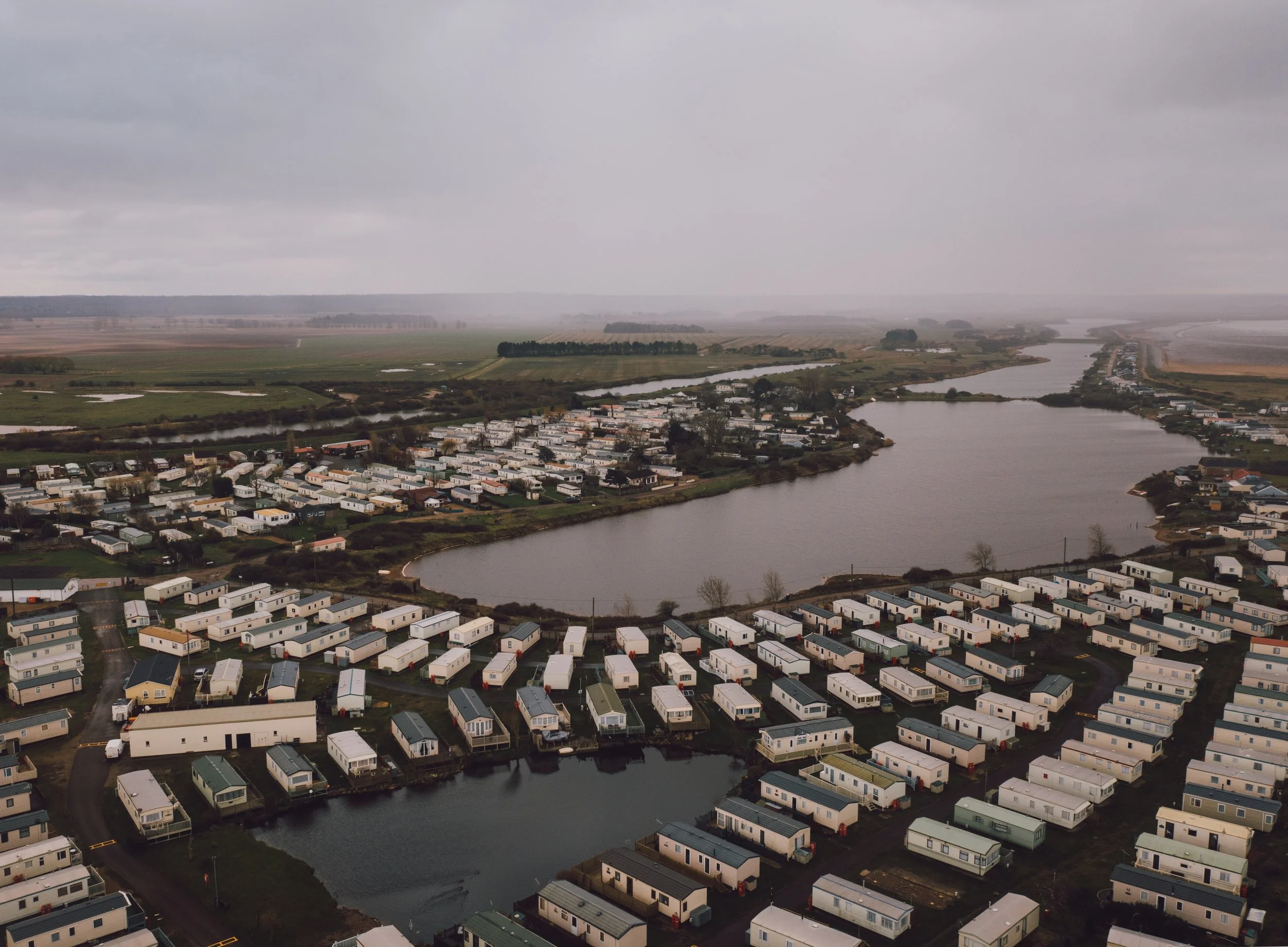
Flood losses in the US now average more than $45 billion a year. Engineers aren't trying to stop that water anymore. They're trying to build things that survive it.
What Is Resilient Infrastructure Design?
Resilient infrastructure isn't the same thing as flood-resistant infrastructure. That distinction matters more than most people realise. Resistance is binary — a levee either holds, or it doesn't. Resilience is something else entirely. It's a system that takes a hit, keeps functioning through the worst of it, and comes back without needing to be rebuilt from scratch. The design goal shifts from "this won't flood" to "when it floods, here's what happens next." The problem with conventional design practice is that it was built on a stable-climate assumption that no longer holds. In September 2023, two storm systems dropped over 200 mm of rain on New York City. Peak intensity topped 75 mm per hour. The city's drainage system was designed for 44. It didn't fail because engineers cut corners — it failed because the underlying assumption was wrong from the start. Climate change doesn't just make floods bigger. It makes the historical record useless as a design baseline. That's the real problem, and it touches every decision: what return period to design for, what materials to specify, how deep to set a foundation, and where to put a pump station.
KEY FIGURES
$45B+ - Average annual US flood losses, current decade
4:1 - World Bank ROI on every $1 spent on climate resilience
500-yr Flood load - MRI now required under ASCE 7-22 Supplement 2
2 yrs - MIT finding: resilient construction pays back in avoided damage
FAIL-SAFE VS. SAFE-TO-FAIL: A CRITICAL DESIGN DISTINCTION
Here's the central tension in flood engineering right now: the infrastructure we've spent a century building was designed not to fail. That sounds right. It isn't. A fail-safe system — a 1-in-100-year levee, a culvert sized for the 50-year storm — performs perfectly until it doesn't. When it's exceeded, the failure is total and instant. No warning, no transition, no graceful exit. Just catastrophe. Safe-to-fail design accepts the uncomfortable truth that a bad enough storm will beat any system you can afford to build. So instead of pretending otherwise, you engineer the failure mode itself. A city plaza that deliberately floods during a major event and drains clean within hours is protecting the buildings around it. A road with a sacrificial surface layer that washes away in a once-in-200-years event — saving the structural base underneath — is doing exactly what it was designed to do. The shift in thinking is this: inundation isn't failure if recovery is fast. Temporary closure isn't a failure if it prevents permanent damage. The question changes from "what flood level can we survive?" to "what do we want to happen when we're overwhelmed?" Practically, this means redundancy, isolation, and recoverability become design criteria just as fundamental as load capacity. A power substation that can be isolated and dewatered in 12 hours is more resilient than one that's never supposed to flood but would take six weeks to restore if it did.
ELEVATION DESIGN: FREEBOARD AND ASCE 24-24
Elevation is the most straightforward resilience tool available. Get the floor above the flood. It sounds almost too simple — and for most of the past 50 years, the argument over how high "above the flood" actually needed to be was settled by a fixed, somewhat arbitrary number. ASCE/SEI 24-24, released in 2024, changed that. It's being described as the biggest upgrade to US flood loss reduction standards since the National Flood Insurance Program set its minimums in 1973, which tells you something about how long the old approach had been running unchallenged. The core change: buildings are no longer designed to the 1-in-100-year Base Flood Elevation plus a fixed freeboard margin. Under ASCE 24-24, most buildings are now designed to resist the 500-year flood load. Critical facilities go higher.
DESIGN FLOOD ELEVATION:
DFE = BFE + Freeboard
Freeboard is now return-period-based, not a flat number:
FDC 1 (low-risk) BFE + 1 ft minimum.
FDC 2 (standard) 500-year SWEL-based elevation
FDC 3 (high-risk) 750-year MRI flood elevation
FDC 4 (essential) 1,000-year MRI flood elevation
SWEL = Still Water Elevation
FDC = Flood Design Class
MRI = Mean Recurrence Interval
Why does the method matter, not just the number? A fixed 1-foot freeboard provides widely varying levels of actual protection depending on your location. In some locations, it adds almost nothing. In others, it's substantial. Moving to a return-period-based elevation means a building in Louisiana and one in Oregon get the same probabilistic protection, not the same arbitrary margin.
Houston's Chapter 19 is already there — it requires finished floors at the 500-year BFE plus 24 inches of freeboard. Most of the country is still catching up.
WHAT FREEBOARD DOES TO YOUR INSURANCE BILL
Going above the NFIP minimum isn't just good engineering. It's usually good finance. An extra 2 to 3 feet above the regulatory minimum typically cuts flood insurance premiums by 20 to 50 percent. On a commercial property, that can mean $3,000–$8,000 off the annual bill, with the additional construction cost paying back in 5 to 12 years, before you count a single dollar of avoided flood damage.
STRUCTURAL DESIGN FOR FLOOD LOADS
Most structural engineers spend their careers designing for gravity loads, wind, and seismic. Flood loads are a different animal. There are five of them, they interact, and you can't treat any one of them as a rounding error.
1. Hydrostatic loads — standing water pushing laterally against walls and foundations, and pushing up on slabs from below. Pressure climbs at 9.81 kN/m² for every metre of depth. Underestimate the uplift and your slab lifts.
2. Hydrodynamic loads — moving water creates drag. The faster it moves, the worse it gets; drag force scales with the square of velocity. Slow-moving floodwater is manageable. Fast-moving floodwater is a structural problem.
3. Wave loads — the one that surprises people. In coastal V Zones, breaking waves can hit with 10 times the force of an equivalent wind load. This isn't a secondary consideration — it governs the design.
4. Debris impact — whatever the floodwater is carrying hits your structure. Columns, piers, and walls at the water surface level take the worst of it. This load is hard to quantify precisely, which is exactly why it gets skipped.
5. Scour and erosion — water moving around a foundation removes the soil supporting it. Slowly, then suddenly. By the time a foundation has scoured enough to cause visible distress, the damage is often already done.
Wave loads govern in coastal V Zones — not gravity loads. ASCE 7-22 Supplement 2 requires deck elevations to be set so that waves don't hit the underside of floor systems. A floor slab in the wave zone can face upward pressure 5 to 10 times its own weight. That's not a load combination most floor designs survive.
FOUNDATIONS
This is the decision that everything else depends on. ASCE 24-24 is unambiguous: buildings in Coastal High Hazard Areas and Coastal A Zones need deep foundations — piles, drilled shafts, caissons. Not spread footings. Foundation depth must account for scour, calculated from actual hydrodynamic analysis, not assumed from a table. The key foundation types and their flood performance characteristics are:
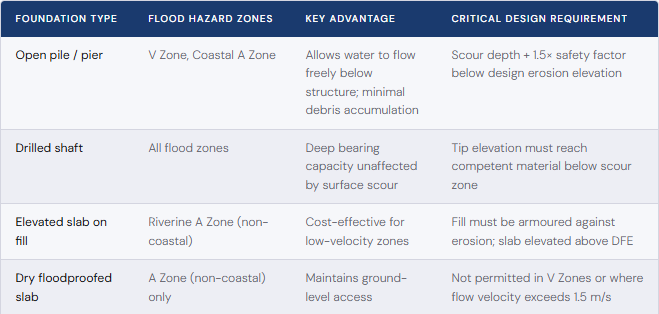
Source: ASCE 24-24 Chapter 4; FEMA Technical Bulletins
MATERIALS
Not all materials fail the same way in a flood, and some fail much faster than you'd expect. ASCE 24-24 classifies materials across five resistance classes — Class 1 can sit permanently in floodwater, Class 5 has to stay above the DFE. Everything in between has conditions attached.
• Concrete and masonry — Classes 1 and 2. Concrete is the default for flood-zone structural elements. One catch: masonry below the DFE needs sulphate-resistant cement and solid units, not hollow. Hollow blocks wick moisture and lose strength over time.
• Steel and aluminium — coated steel is Class 2, aluminium and stainless are Class 1. Uncoated mild steel in prolonged inundation doesn't just rust — it degrades structurally faster than most project timelines account for.
• Fibre-reinforced polymers (FRP) — Class 1. Strong, light, corrosion-proof, stable when wet. The reason FRP isn't used everywhere is cost, not performance. In flood-exposed applications, the cost argument weakens considerably.
• Timber — the range here is wide. Properly treated timber above ground is Class 2 and usable. Untreated timber below the design flood envelope is not appropriate, full stop.
• Self-healing concrete — still emerging, but worth watching. Encapsulated agents activate when cracks form and reseal them, which matters enormously in structures that cycle between wet and dry.
DRAINAGE: STOP DESIGNING FOR THE PAST
Drainage networks are sized against historical rainfall records. That made sense when the climate was stable. It doesn't anymore.
The physics is called Clausius-Clapeyron scaling. For every degree of warming, the atmosphere holds about 7% more water — and when it releases that water, it comes faster. Design for what the sky used to do and you're already behind.
RATIONAL METHOD:
Q = C × I × A
CLIMATE-ADJUSTED INTENSITY:
I_design = I_historical × (1 + α × ΔT)
α ≈ 0.07 per °C of warming
ΔT = projected warming over the asset's design life
Example — 50-year asset life, 1.5°C projected warming: I_design = I_historical × 1.105 (that's +10.5%)
Ten and a half percent doesn't sound like much. But it's enough to push your drainage network into the next pipe size class across the board. On a large system, that's a 15 to 25% increase in pipe costs that you didn't budget for—because you used yesterday's rainfall numbers to design tomorrow's infrastructure.
LAYERS OF DEFENCE
One line of defence is liability. When it fails—and it will—there's nothing behind it. The trend across every serious flood engineering program in the world is toward layered systems, where each layer reduces what the next one has to handle.
• Offshore barriers — reefs, breakwaters, restored oyster beds. These absorb wave energy before it reaches the shore. They also don't require a construction crew to deploy when a storm arrives.
• Coastal wetlands — mangroves, saltmarsh, dunes. Storm surge attenuation ranges from 5 to 50 cm per kilometre of wetland width. Singapore cut its flood-prone area by 30% by integrating these with its engineered drainage. They're also self-maintaining in ways that concrete is not.
• Levees and floodwalls— still necessary, but as the second or third layer, not the first and only one.
• Upgraded urban drainage — bigger pipes, underground storage, surface detention. Sized against the climate-adjusted numbers above, not the historical record.
drainage—bigger pipes, underground storage, and• Building-level barriers — removable shields, certified flood doors (ANSI/FM 2510), membrane systems. Last line of defence. Unglamorous. Essential.
NATURE-BASED SOLUTIONS: USEFUL, NOT A SUBSTITUTE,
There's a version of the nature-based solutions conversation that's honest and a version that isn't. The honest version: NbS works, the numbers are real, and they belong in any serious flood resilience programme. The dishonest version: they're cheaper alternatives to hard engineering that can replace it.
They can't. They complement it. That distinction matters when budgets get tight, and someone proposes swapping a detention basin for a wetland and pocketing the difference.
The performance data is solid. Indonesia saw a 40% increase in measured infrastructure resilience after investing in urban NbS. Thailand reduced its flood vulnerability by 25% with a combined green and blue infrastructure programme. Wetland restoration in riverine catchments consistently delivers 10 to 30% peak flow attenuation, which directly reduces the size and cost of everything downstream.
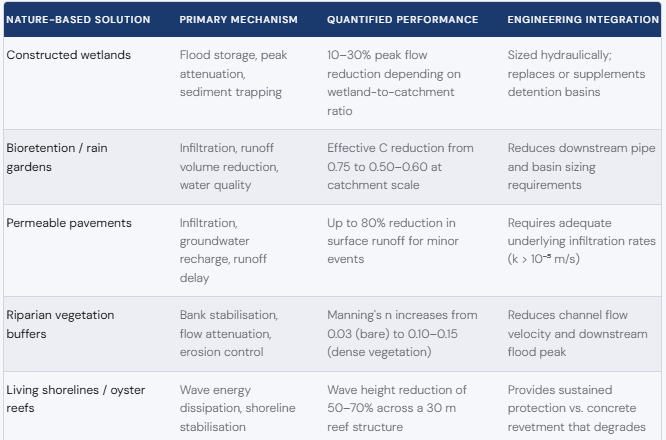
Sources: ACS ES&T Water (2024); ASCE Coastal Engineering; WSUD research
One rule applies to all of them: if you can't specify the performance in hydraulic terms — a Manning's n value, an infiltration rate, a storage volume — it's not ready to go into a design. Good intentions aren't a substitute for numbers.
MONITORING: BUY TIME, NOT RECORDS
A resilient infrastructure system doesn't run unsupervised. It's watched, and what you do with what you're watching determines how useful it is.
The most important thing a monitoring system can give you is time. A sensor network that detects an approaching event hours out—not minutes— is the difference between activating flood gates and scrambling to sandbag. Sensors that tell you how devastating the damage was after the fact are useful for insurance claims. They don't save anything.
• IoT water level and flow sensors — the backbone. Real-time data on flood propagation across a network, feeding directly into operations decisions.
• AI flood prediction — 24 to 72-hour event forecasting at street-level resolution is now operational in major cities. New York and Jakarta have both used it to inform infrastructure design decisions, not just emergency response.
• Digital twins — live models of infrastructure systems, updated by sensor feeds. You can run a developing storm through the model before it hits and see exactly which assets are at risk.
• Remote sensing and GIS — Landsat NDVI and NDWI indices now map annual flood risk at parcel-level accuracy, backed by over 40 years of rainfall records. Useful at the planning stage, before anything gets built.
DESIGN REFERENCE SUMMARY
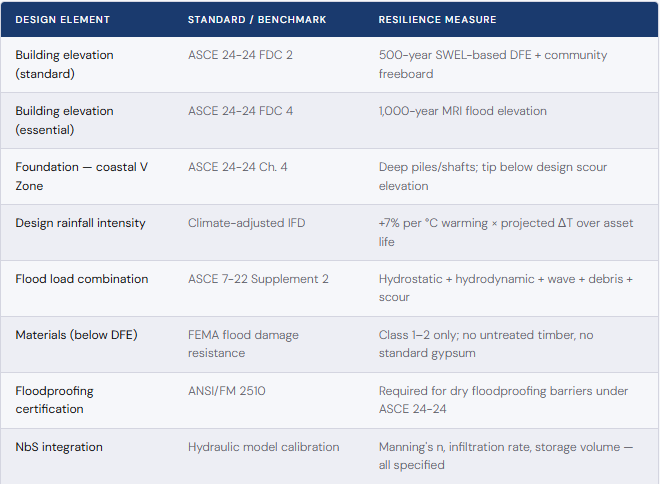
Reference: ASCE 24-24; ASCE 7-22 S2; FEMA Technical Bulletins; ACS ES&T Water (2024)
CONCLUSION
The assumptions underneath conventional flood engineering aren't just outdated — some of them were always wrong. Historical rainfall isn't a reliable baseline anymore. A single line of defence works until it fails. Fixed freeboard margins give different people different levels of protection depending on where they happen to live. ASCE 24-24 addresses all three. So do the jurisdictions that have invested seriously in resilience – not because it was cheap, but because the World Bank arithmetic is hard to argue with: four dollars back for every one spent on resilience. The standard has moved. The current task is to design in advance.
