
Green Stormwater Infrastructure: How Bioretention, Rain Gardens, and Permeable Paving Are Replacing Gray Systems
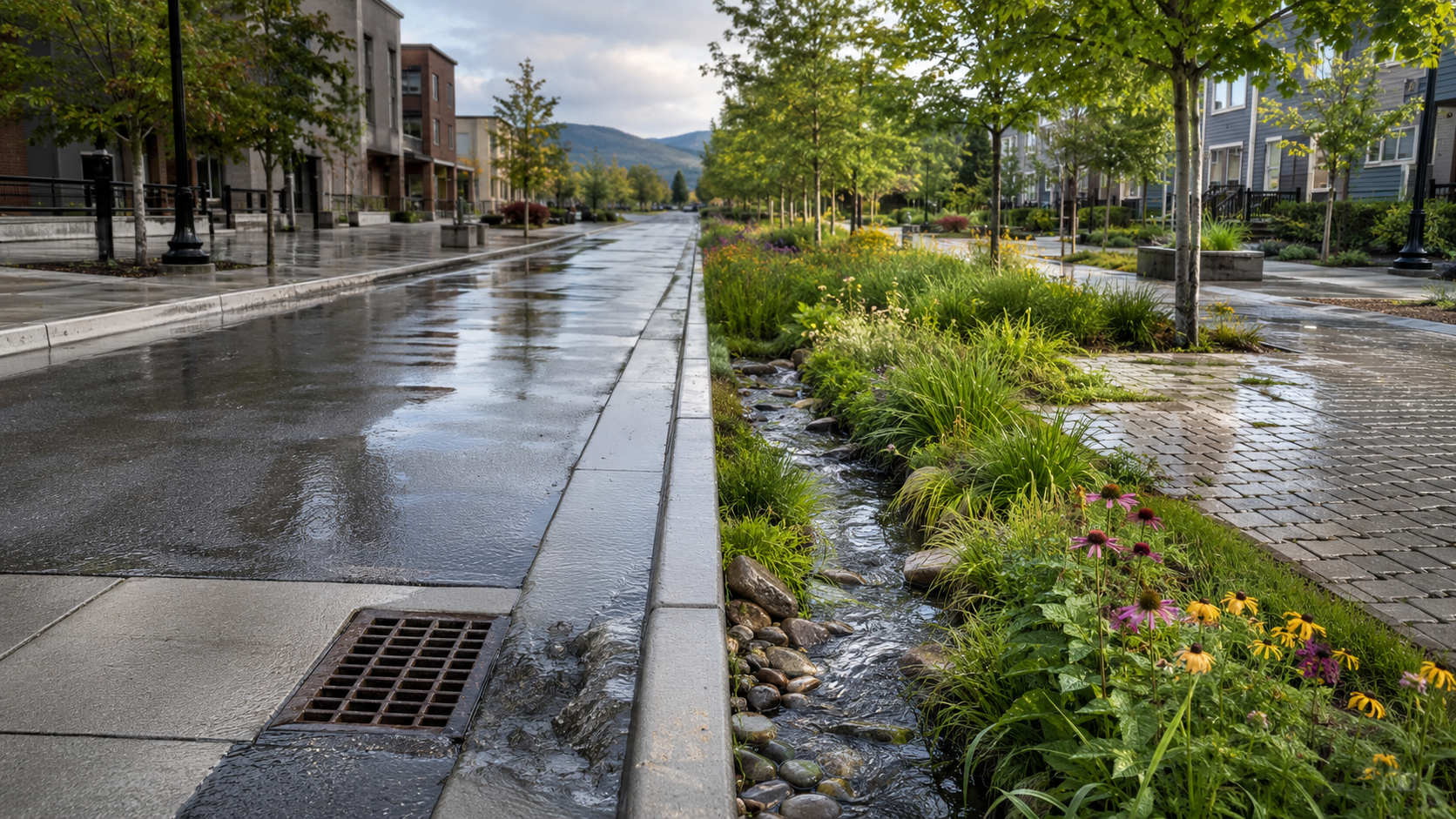
The traditional approach to stormwater management was straightforward: collect the water as fast as possible, pipe it away, and send it somewhere else. That somewhere else was typically a stream or river, which received a pulse of fast-moving, polluted runoff every time it rained. The infrastructure to accomplish this, pipes, inlets, detention basins, catch basins, all of it engineered to move water quickly, is what stormwater engineers call gray infrastructure.
ASCE gave stormwater a D on its 2025 Infrastructure Report Card. The 20-year capital need for stormwater systems nationally jumped from $23.8 billion in 2012 to $115.3 billion in ASCE's 2022 assessment. The gray infrastructure that collects stormwater in most American cities is aging, undersized for modern precipitation intensity, and increasingly failing to meet the water quality standards that EPA and state regulators enforce through the Municipal Separate Storm Sewer System (MS4) permit program.
Green stormwater infrastructure is a fundamentally different approach. Instead of collecting and moving water, it slows it down, spreads it out, and puts it back where it came from: into the soil, plants, and groundwater that nature used before development covered the land with impervious surfaces. Rain gardens, bioretention basins, permeable pavement, green roofs, bioswales, and constructed wetlands are all elements of this approach.
The regulatory environment has shifted decisively in favor of green infrastructure over the past decade. Many MS4 permits now require low-impact development (LID) as the preferred stormwater approach for new development and redevelopment, with gray infrastructure allowed only when LID is infeasible. For developers and engineers designing new projects, understanding how green stormwater infrastructure works and when it applies is no longer optional.
1. Why Gray Infrastructure Is Losing Ground
The problem with gray stormwater infrastructure isn't that it doesn't work. It does, within its design parameters. The problem is that those design parameters were set for a different city, a different climate, and different water quality standards than what exist today.
When a storm hits a developed area, impervious surfaces, roads, rooftops, parking lots, prevent rainfall from soaking into the ground. Water runs off the surface instead, picking up oil, nutrients, bacteria, heavy metals, and other pollutants as it goes. This polluted runoff reaches storm drains and travels through pipes to a receiving water body. The rate, volume, and pollutant load of that runoff is substantially higher than what the same area produced before it was developed.
Gray infrastructure can handle the flow, at least up to its design storm. But it doesn't address the water quality problem: everything in that runoff goes to the receiving water. And it doesn't address the groundwater problem: rainfall that used to recharge aquifers through natural infiltration now travels directly to surface water. In regions where groundwater serves as a drinking water source, the loss of natural recharge from development contributes to long-term aquifer depletion.
Green infrastructure addresses both problems simultaneously. By slowing runoff and infiltrating it into the soil, it removes pollutants through biological and physical processes in the root zone, reduces the volume and peak rate of runoff reaching receiving waters, and replenishes groundwater that would otherwise be lost.
D
ASCE's 2025 grade for U.S. stormwater infrastructure. Tied with transit for the lowest grade of any infrastructure category. The 20-year capital need grew from $23.8 billion in 2012 to $115.3 billion in 2022.
2. The Green Infrastructure Toolkit
There are more GSI tools than most developers realize when they first encounter this requirement. The appropriate tool depends on the site conditions, the regulatory requirement, and the space available.
Bioretention and rain gardens
Bioretention is the workhorse of green stormwater infrastructure. A bioretention facility is a shallow, planted depression with engineered soil media that collects runoff from an impervious area, filters it through the root zone, and either infiltrates it to the groundwater or releases it slowly through an underdrain to the storm sewer. Rain gardens are the residential-scale version of the same concept.
The design rule of thumb: a bioretention facility needs to be about 3 to 5 percent of the contributing impervious area to manage the water quality capture volume required by most MS4 permits. On a one-acre project with 30,000 square feet of impervious surface, that's 900 to 1,500 square feet of bioretention. The facility needs to have native soil with an infiltration rate above about 0.5 inches per hour to infiltrate rather than drain to underdrains, and it needs at least 3 to 5 feet of vertical separation from the seasonal high groundwater table to avoid contamination risk from saturated conditions.
Bioswales
A bioswale is a gently sloping, vegetated channel designed to slow runoff, allow sediment to settle, and provide some infiltration as water moves through the planted channel. Bioswales are a natural fit for parking lot perimeters, roadway medians, and the strips along buildings where conventional landscaping would provide no stormwater benefit. They convey runoff slowly rather than capturing it in one place, and they work well in series with bioretention facilities where the swale collects and partially treats runoff before directing it to a larger bioretention area.
Permeable pavement
Porous asphalt, pervious concrete, and permeable interlocking pavers all allow water to pass through the surface and into the subgrade below. In the right soil conditions, water infiltrates to the groundwater. In poor infiltration soils, an aggregate base course below the pavement stores the water temporarily while it slowly infiltrates or is directed to an underdrain.
Permeable pavement is especially valuable in parking lots, which are among the largest impervious surfaces on most development sites. Replacing conventional asphalt in low-traffic parking areas with permeable pavement can eliminate a substantial portion of a site's stormwater management requirement. The maintenance requirement is real: permeable pavement needs periodic vacuuming to prevent sediment clogging, and it's generally not appropriate for high-traffic lanes where heavy loads would reduce pavement longevity.
Green roofs
A green roof is a vegetated roof system that absorbs and delays rainfall at the rooftop. Extensive green roofs, the thinnest and lightest type, use 4 to 6 inches of growing medium and shallow-rooted plants like sedums. They typically absorb 40 to 80 percent of annual rainfall depending on climate and design. Intensive green roofs, with deeper growing medium and more diverse plant communities, provide more stormwater benefit but add more structural load and require more maintenance.
Green roofs are most cost-effective in dense urban environments where land for ground-level green infrastructure is limited and the cost premium of a green roof can be offset by the avoided cost of mechanical stormwater management, reduced energy use from the insulating effect, and increased roof membrane lifespan.
Tree wells and structural soil cells
Street trees provide stormwater benefits through interception and transpiration, but only if their root systems are healthy and their soil volume is adequate for the tree's size. Silva Cells and similar structural soil cell systems provide a load-bearing subgrade structure that supports pavement above while providing a large volume of uncompacted, well-aerated soil for tree root growth. Combined with surface inlets that direct runoff into the soil cell volume, these systems can provide both significant tree root support and meaningful stormwater storage.
3. How to Know Whether Green Infrastructure Will Work on Your Site
Green stormwater infrastructure isn't appropriate for every site. The site conditions that determine feasibility are straightforward to assess, and a stormwater engineer should evaluate them early in the site design process.
Native soil infiltration rate: If the native soil can't absorb water at a rate above about 0.5 inches per hour, infiltration-based green infrastructure doesn't work. The water has to go somewhere. In poor-drainage soils, bioretention facilities need to be designed with underdrains that slowly release captured water to the storm sewer, which reduces the volume benefit but maintains the water quality treatment benefit.
Groundwater depth: Infiltration facilities need at least 3 to 5 feet of vertical separation from the seasonal high groundwater table. In areas with shallow groundwater, infiltrating potentially polluted stormwater can contaminate drinking water supplies. Shallow groundwater may require flow-through or above-grade designs that provide treatment without infiltration.
Available space: Bioretention facilities need to be sized for their contributing impervious area. On a tight urban infill site, fitting adequate bioretention area within the development footprint may require creative layout. Flow-through planters, green roofs, and permeable pavement are particularly useful in space-constrained urban conditions.
Site slope: Steeper sites complicate bioretention design because runoff velocity is higher and the topography makes establishing level ponding areas more challenging. Terraced bioretention in series down a slope, or bioswales that meander across the slope to slow velocity, can address slope constraints.
What MS4 Permits Actually Require
MS4 permits under the NPDES program require municipalities to control stormwater quality and quantity. In a significant shift over the past decade, many Phase I and Phase II MS4 permits now require new development and redevelopment above a certain threshold to manage the water quality capture volume, typically the first inch or so of rainfall, on-site using LID practices. The permit requirement isn't to install a specific GSI type. It's to achieve a performance standard. Designers have flexibility in which combination of GSI tools they use to meet that standard. Understanding the specific water quality capture volume requirement and the sizing methodology required by the applicable MS4 permit is the starting point for any development stormwater design in a regulated area.
4. What This Means for Developers
Green infrastructure is no longer optional in most regulated jurisdictions. Post-construction stormwater requirements have become more stringent in the years since the IIJA funded expanded stormwater regulation, and developers who aren't designing LID into their projects from the beginning are discovering the requirement late in the permitting process, at a point when the site layout is already set and retrofitting adequate stormwater management is expensive.
The practical implication is that the stormwater engineer should be in the design team from the beginning of site layout, not brought in at the end to solve the drainage problem. Site layout decisions, where the impervious areas are, where the topography drains, where there's space for vegetated facilities, directly determine how easily and cost-effectively the stormwater requirement can be met. A site layout that was designed without stormwater in mind and then handed to a stormwater engineer frequently produces expensive solutions because the space for green infrastructure wasn't preserved.
For homeowners, rain gardens and permeable patio materials are increasingly part of residential stormwater management requirements in regulated areas. In many jurisdictions, residential redevelopment above a certain threshold, adding a patio, replacing a driveway, building an addition, triggers post-construction stormwater requirements. Understanding whether your project triggers those requirements before you start is simpler and cheaper than discovering it during permit review.
Conclusion
Green stormwater infrastructure works best when it's treated as an integrated part of site design rather than a stormwater compliance checkbox. Rain gardens that are designed as genuine landscape features, bioswales that define pedestrian pathways through a site, permeable pavement in parking areas that also reduces heat island effect: these are design decisions that serve multiple purposes simultaneously and produce better sites than the same investments made separately.
The stormwater D that ASCE assigned in 2025 reflects decades of gray infrastructure underinvestment and an approach to development that treated stormwater as a problem to be piped away rather than a resource to be managed. Green infrastructure offers a different model. It's increasingly required, it's increasingly well-understood, and it produces better sites.
