
Drought-Resistant Landscaping as Infrastructure: Water Conservation in an Era of Scarcity
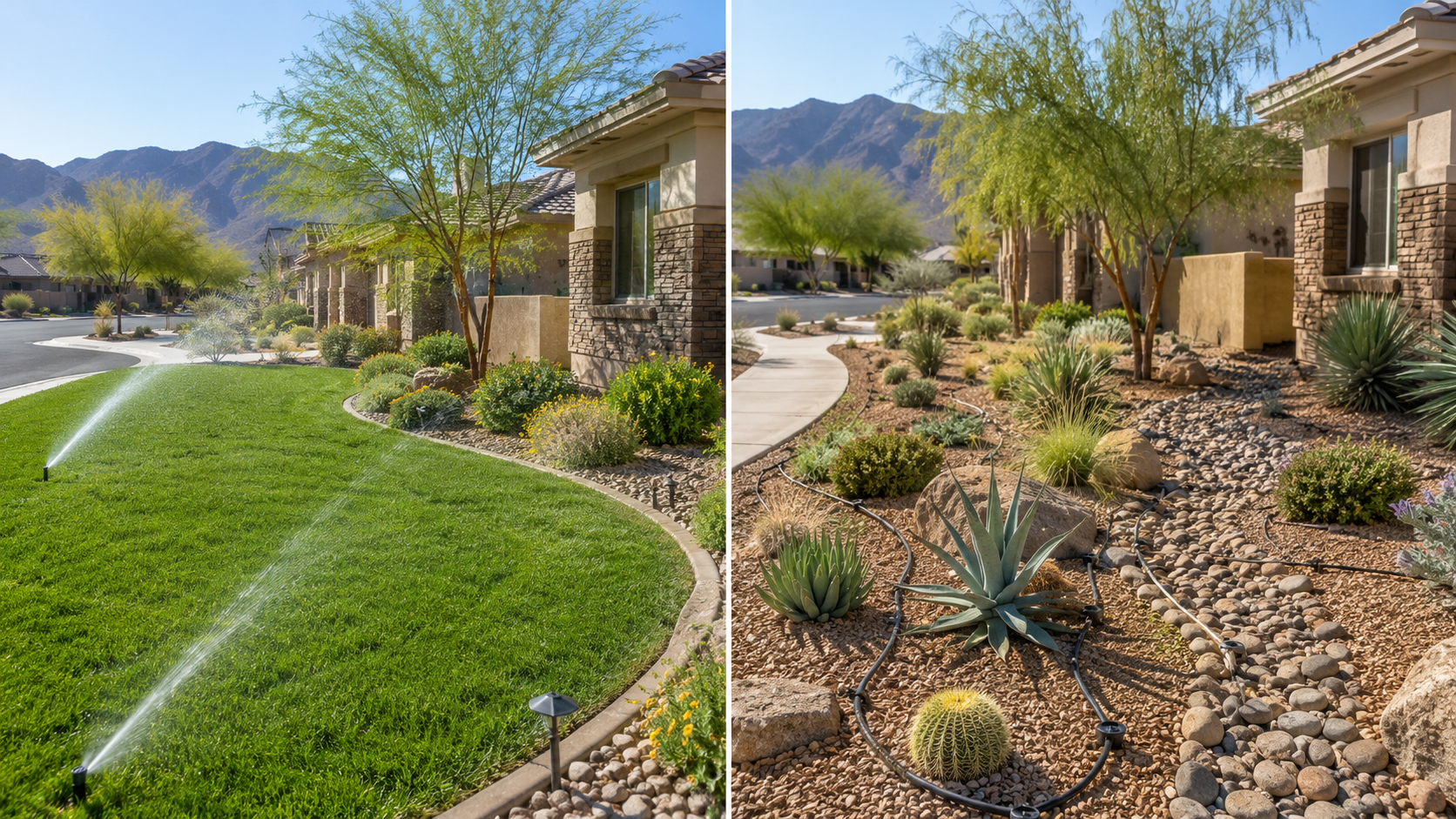
The United States uses about one-third of all residential water on outdoor irrigation. Most of that water goes to lawns. Traditional Kentucky bluegrass in Colorado requires 40 to 60 gallons of water per square foot every year to stay green. A comparable xeriscape, using drought-tolerant plants and water-efficient design, requires 10 to 15 gallons per square foot. That's not a modest improvement. It's a fundamentally different relationship between a property and its local water supply.
This matters increasingly because western water supplies are under pressure they haven't faced before. Texas projections from the state water plan show municipal water demand rising 63 percent over the next 50 years while water supply drops 18 percent. Southern Nevada has been removing grass and paying homeowners to replace it since 1999. Colorado passed legislation in 2021 preventing HOAs from forcing homeowners to maintain traditional turf during drought conditions. Nevada followed with a 2026 deadline banning nonfunctional turf from commercial properties and public spaces.
Drought-resistant landscaping is no longer a preference or an aesthetic choice for certain homeowners. It's becoming required infrastructure in large parts of the country, backed by rebate programs, regulatory mandates, and practical necessity. This post covers what drought-resistant landscaping actually involves, what the design principles are, and what property owners, developers, and communities need to know to design and maintain landscapes that are genuinely adapted to the climate they're in.
1. Drought-Resistant vs. Drought-Tolerant: A Distinction That Matters
The terms drought-resistant and drought-tolerant are often used interchangeably, but they describe different things, and the distinction matters for design and plant selection.
Drought-tolerant plants can survive extended dry periods with little or no supplemental irrigation once established. They've developed mechanisms, deep root systems, reduced leaf surface area, waxy coatings, or the ability to go dormant during dry periods, that allow them to function in arid or semi-arid conditions without relying on irrigation to stay alive.
Drought-resistant landscaping is the broader design approach that maximizes water efficiency across the entire landscape system. It includes plant selection, but it also includes soil preparation to improve water infiltration and retention, efficient irrigation design that gets water to plant roots without waste, hardscape design that minimizes water-demanding surfaces, mulching to reduce evaporation, and grouping plants with similar water needs so irrigation can be calibrated precisely.
A drought-resistant landscape isn't necessarily devoid of irrigation. It uses irrigation strategically, for newly planted specimens that need establishment support, for high-value plantings in high-visibility areas, and for food production zones where consistent water is needed for yield. The goal is to minimize irrigation demand relative to conventional landscaping, not necessarily to eliminate it entirely.
120 gallons per day
The estimated daily water savings for a household that converts from conventional lawn to xeriscape. Across an entire neighborhood, those individual savings add up quickly.
2. The Seven Principles of Xeriscape
Denver Water coined the term xeriscape in 1981, combining the Greek word xeros (dry) with landscape to describe a systematic approach to water-efficient landscaping. The seven principles have been adapted and refined over 45 years of application across the American West and Southwest.
1. Planning and design. Start with a site plan. Identify which areas receive full sun, which are shaded, which have existing soil conditions that favor certain plants, and where water naturally flows during rainfall. Group areas by function and water need. A food garden needs more water than a native planting; a high-visibility entry needs different treatment than a back fence line.
2. Soil analysis and improvement. Most conventional lawns sit on compacted, nutrient-depleted soil that was graded during construction and never restored. Drought-resistant landscapes need soil that absorbs water efficiently and retains moisture long enough for roots to access it. Adding organic matter, aerating compacted areas, and amending soil pH for the specific plants being used makes a substantial difference in how much irrigation the landscape needs.
3. Practical turf areas. This principle asks where grass actually needs to be, not where it conventionally is. Play areas, dog runs, pathways between gathering spaces: these are functional places for turf. Parkway strips between the sidewalk and street, side yards that nobody uses, ornamental grass panels in front of commercial buildings: these rarely need to be turf and almost always perform better as drought-tolerant alternative ground covers.
4. Appropriate plant selection. Choose plants adapted to the local climate. In the American West and Southwest, that means plants that have evolved in arid or semi-arid conditions. It doesn't mean limiting yourself to cacti and gravel. Native perennials, ornamental grasses, drought-tolerant shrubs, and carefully selected non-invasive plants from similar climate zones around the world can create landscapes that are lush, colorful, and ecologically valuable while using a fraction of the water a conventional design requires.
5. Efficient irrigation. Drip irrigation delivers water directly to plant root zones with minimal evaporation loss. Weather-based smart controllers adjust irrigation schedules based on actual evapotranspiration rates rather than running on a fixed schedule regardless of whether it rained yesterday. Soil moisture sensors cut irrigation when the soil already has adequate water. These technologies together can reduce irrigation water use by 30 to 50 percent compared to conventional timer-based spray systems.
6. Mulching. A 3-inch layer of appropriate mulch, inorganic in fire-prone areas, wood-based elsewhere, reduces soil moisture evaporation by 25 to 50 percent, moderates soil temperature, suppresses weeds, and improves soil structure over time. Mulch is one of the most cost-effective water conservation measures in any landscape.
7. Appropriate maintenance. A drought-resistant landscape isn't no-maintenance. It requires seasonal pruning to remove dead material, irrigation system adjustments as plant establishment progresses, occasional weed management, and monitoring for plant health. But the maintenance load is substantially less than a conventional turf landscape, and the skills required are more ecological than mechanical.
3. The Regulatory and Incentive Landscape
The policy environment around drought-resistant landscaping has changed substantially in the past few years, and the direction of change is consistent: more requirements, more incentives, and fewer barriers from HOA restrictions.
State and local mandates
Nevada's 2021 law banning nonfunctional turf from commercial properties, government buildings, and public spaces by 2026 is the most aggressive mandate in the country. Nonfunctional turf is defined as turf that is not regularly used for recreation or civic purposes, which captures the grass medians, parking lot islands, commercial entry corridors, and ornamental strips that make up a substantial share of municipal and commercial irrigation demand in arid regions.
Colorado's HB 21-1229 took a different approach, protecting homeowners rather than mandating change: HOAs cannot require homeowners to maintain traditional bluegrass lawns, cannot penalize xeriscaping installations, and cannot restrict drought-tolerant landscaping choices. For developers and HOA administrators, this law means that CC&Rs in new Colorado communities need to be drafted with xeriscape-permissive language, and that enforcement actions against homeowners who have converted to drought-tolerant landscaping may be legally vulnerable.
Many municipalities across the Southwest have adopted permanent outdoor watering restrictions, time-of-day limitations, and seasonal irrigation schedules that effectively require drought-tolerant landscaping to maintain any kind of landscape health within the allowed watering windows.
Rebate programs
The Southern Nevada Water Authority's Water Smart Landscapes program has been paying homeowners and businesses to remove turf since 1999. By 2020 it had distributed $247 million in rebates, replaced 197 million square feet of grass, and saved 140 billion gallons of water. It's the longest-running and most documented turf replacement program in the country, and its long track record makes a compelling case for the cost-effectiveness of financial incentives for landscape conversion.
Denver Water's Cash for Grass program offers similar rebates. Many California water districts offer tiered rebate programs. The structure is consistent: property owners receive a per-square-foot payment for turf removed and replaced with drought-tolerant landscaping, typically with verification requirements to ensure the replacement is genuine rather than simply removing grass and leaving bare soil.
4. Greywater Reuse: The Other Half of the Water Equation
Outdoor irrigation accounts for a significant share of residential water use, but the water supply for that irrigation doesn't have to be potable water. Greywater, water from sinks, showers, and laundry that hasn't been contaminated with sewage, is suitable for landscape irrigation after appropriate treatment. California legalized residential greywater reuse from laundry and bathroom sinks under specific conditions, and several other western states have followed with similar provisions.
A greywater irrigation system captures laundry water or bathroom sink water and routes it to subsurface drip irrigation in landscape planting areas. The system doesn't meet every irrigation need, but it reduces potable water demand for irrigation by 30 to 50 percent in typical residential applications. For developments in areas with water budget ordinances or allocation constraints, greywater reuse can be a meaningful component of the overall water conservation strategy.
5. What This Means for Developers
Water budget compliance is increasingly a development approval requirement in Western states. Many municipal water districts require developments to demonstrate that projected water use falls within a defined budget before approvals are issued. Landscape design that specifies high-irrigation-demand plants and conventional turf creates water budget problems that can hold up permits. Drought-resistant landscape design is the path to comfortable budget compliance.
For developers designing HOA communities, the lesson from Colorado is to write xeriscape-permissive language into the CC&Rs from the beginning. Communities that give homeowners clear options for drought-tolerant landscaping, with design guidelines that ensure aesthetic coherence without mandating water-intensive plant choices, are both legally compliant and more marketable in markets where water costs and restrictions are visible to buyers.
For commercial developers in water-restricted markets, the Nevada experience is instructive: ornamental turf in parking lot islands, entry medians, and building frontages is increasingly both legally restricted and economically inefficient. Designing commercial landscapes with drought-tolerant alternatives from the start avoids the cost of future mandatory conversion and reduces ongoing irrigation operating costs.
For Homeowners
The most practical first step for any homeowner in a water-stressed region is to walk the property and identify where turf is actually being used versus where it's simply conventional. The side yard nobody walks through, the parkway strip between the sidewalk and the street, the ornamental strip under the front window: none of these need to be turf. Converting them to drought-tolerant ground cover or planting beds with appropriate mulch reduces irrigation demand, reduces maintenance, and in most western states qualifies for rebate payments that partially offset the conversion cost.
Conclusion
Drought-resistant landscaping isn't a sacrifice. It's a design problem with good solutions, and the best examples, well-designed native and adaptive plant communities with efficient irrigation and appropriate mulching, are beautiful, ecologically valuable, and substantially less demanding to maintain than the conventional lawns they replace.
The water math in the western United States is not going to improve. Demand is increasing, supply is constrained, and the climate conditions driving both trends are not reversing. Designing landscapes that are adapted to the actual climate of their location isn't environmental virtue signaling. It's sound infrastructure design that will age better than landscapes built for a water supply that no longer exists in the quantities conventional landscaping assumed.
