
Dual-Hazard Design: Engineering Structures to Resist Both Wildfire and Seismic Loads
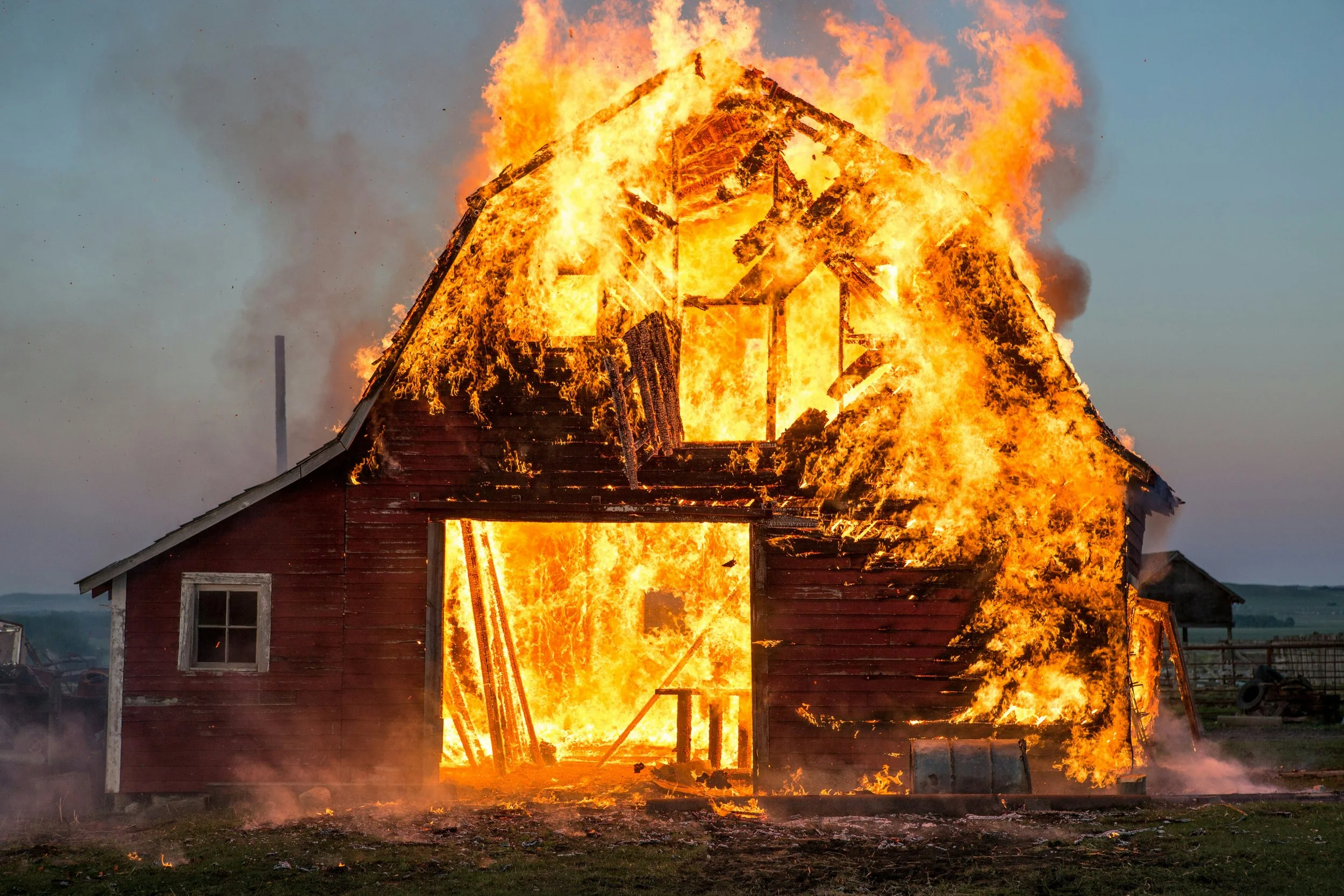
If you design structures in California, Oregon, Washington, or any other state where wildfire risk and seismic hazard overlap, you're designing in a dual-hazard environment whether your code checklist says so or not. The 2025 Los Angeles wildfires destroyed more than 16,000 structures in communities that also sit directly above some of the most active fault systems in North America. Those two facts aren't coincidental. They're the defining constraint for structural engineering in the wildland-urban interface.
The problem is that code compliance for each hazard has historically been treated as a separate exercise. You satisfy ASCE 7-22 seismic requirements. You satisfy CBC Chapter 7A or the new Title 24, Part 7 WUI code for fire resistance. You check both boxes. What hasn't been developed until recently is a design philosophy that asks how these two sets of demands interact and, more importantly, how they can be satisfied together in a way that produces structures genuinely capable of surviving both.
This post lays out the engineering basis for dual-hazard design. It covers the coupled nature of the fire and seismic hazard in California and similar regions, the fundamental tension between structural systems optimized for seismic ductility and those optimized for fire resistance, the code framework that governs each hazard, the structural system selection trade-offs, the connection detailing strategies where fire and seismic needs converge, and the practical case for treating dual-hazard design as a single integrated engineering problem rather than two parallel compliance checklists.
1. Two Hazards, One Building: The Coupled Risk That Code Treats Separately
California's seismic and wildfire hazards share geography almost completely. The communities most exposed to wildfire, those built into hillside terrain at the urban fringe, the canyons, the ridge-top neighborhoods of Los Angeles, the foothills of the Sierra Nevada, the coastal slopes of Northern California, are frequently built on or immediately adjacent to active fault zones. The San Andreas, the Hayward, the Newport-Inglewood, the Puente Hills: all pass through or beneath exactly the kinds of communities that burned in 2017, 2018, and 2025.
This overlap creates what structural fire researchers call a coupled hazard scenario. The two events, wildfire and earthquake, don't have to occur simultaneously to interact in structurally significant ways. They produce compounded vulnerability through three distinct pathways.
Fire following earthquake
Fire following earthquake (FFE) is a well-documented phenomenon with a long historical record. The 1906 San Francisco earthquake caused fires that burned for three days and destroyed more of the city than the ground shaking. The 1994 Northridge earthquake triggered multiple fires through ruptured gas lines and damaged electrical systems. The pathway is consistent: ground shaking damages gas infrastructure and electrical connections, ignition sources accumulate, and a fire environment emerges in a built fabric that has been structurally weakened by the preceding shaking. A building that survived the earthquake with moderate structural damage may have a compromised lateral force resisting system, damaged connections, and weakened diaphragm continuity. That building is then exposed to fire with a fraction of its original structural capacity.
Seismic vulnerability compounded by fire damage
The inverse pathway matters equally in wildfire-prone zones. A structure that has survived a wildfire with fire damage to its lateral system, whether a wood-framed shear wall that has been partially charred, anchor bolts that have been bent or corroded at hold-down locations, or a concrete foundation that has lost compressive strength in the zones connecting to the superstructure, is subsequently more vulnerable to seismic loading. The lateral force resisting system that code designed to handle earthquake forces may no longer be capable of doing so. This is the scenario ASCE flagged in its 2025 post-wildfire reporting: a structure whose lateral system was compromised by wildfire damage that went undetected or was underestimated in post-fire assessment could fail in a seismic event that a pre-fire version of the same building would have survived.
The design mismatch
The most structurally significant aspect of the coupled hazard problem is that the most common lateral force resisting system used in residential and low-rise commercial construction in WUI California is wood light-frame: wood structural panels attached to wood stud framing to form shear walls. This system has a long track record of adequate seismic performance under well-designed and well-built conditions. It has essentially no fire resistance as a structural system. The wood that provides the energy dissipation and ductility in a seismic event is the first material that combusts in a wildfire. The system you designed to survive an earthquake is the system that fails first in a fire.
The Core Dual-Hazard Tension
Seismic design optimization favors ductility: materials and connections that can deform significantly before failing, absorbing energy without catastrophic collapse. Wood light-frame construction achieves this well. Wildfire resistance optimization favors noncombustibility: materials that don't ignite or contribute to fire spread. Wood light-frame construction achieves this poorly. The systems that perform best in one hazard perform worst in the other. Resolving that tension without simply abandoning one performance objective is the central design challenge in dual-hazard structural engineering.
2. The Code Framework: ASCE 7-22, CBC 2025, and Title 24 Part 7
Understanding what each code requires, and where the requirements create design conflicts or design opportunities, is foundational for dual-hazard work.
Seismic: ASCE 7-22 and CBC 2025
ASCE 7-22 is the governing load standard referenced by CBC 2025 for seismic design. Chapter 11 establishes seismic hazard parameters through the Risk-Targeted Maximum Considered Earthquake (MCER) framework. Chapter 12 prescribes seismic design requirements for building structures, including the assignment of structures to Seismic Design Categories (SDC) A through F based on occupancy (Risk Category) and site-specific ground motion parameters. Most residential and commercial construction in high-seismicity California falls into SDC D, E, or F, the highest categories, which carry the most stringent detailing requirements for whatever structural system is selected.
Table 12.2-1 of ASCE 7-22 lists the permitted seismic force-resisting systems (SFRS) with associated response modification coefficients (R), overstrength factors, and deflection amplification factors for each system and SDC. The R factor is central to how seismic demands are calculated: it represents the ductility and overstrength a system provides, allowing reduced elastic design forces in exchange for the assumption that the system will perform inelastically during a design-level earthquake. Higher R values mean lower design forces, which is why wood light-frame shear walls (R up to 6.5) and steel special moment frames (R = 8) are popular in high-seismic zones. Lower-ductility systems carry lower R values and require larger design forces.
ASCE 7-22 added new lateral force resisting systems including reinforced concrete ductile coupled shear walls and cross-laminated timber (CLT) shear walls, expanding the code-recognized toolkit for engineers working at the intersection of fire and seismic design requirements.
Wildfire: Title 24, Part 7 (California WUI Code 2025)
Effective January 1, 2026, California consolidated its wildfire construction requirements into a new standalone code: Title 24, Part 7, the California Wildland-Urban Interface Code. This reorganizes what was previously scattered across CBC Chapter 7A, Section R337 of the Residential Code, and Chapter 49 of the Fire Code into a single, integrated document, and represents the most significant restructuring of wildfire construction standards in California in decades.
The WUI Code applies to all new buildings and exterior alterations in Fire Hazard Severity Zones (FHSZ) designated as Moderate, High, or Very High by CAL FIRE, as well as locally designated WUI Fire Areas. The code's architecture addresses the building as a system rather than a collection of independent components. The primary ignition threats it's designed against are ember intrusion and radiant heat exposure, not direct flame contact. Research consistently shows that ember intrusion through vulnerable openings is the leading cause of structure ignition in wildfire events, which is why vent protection and opening hardening receive detailed attention.
The key requirements and their structural implications
Several WUI Code requirements have direct structural implications that engineers need to integrate into their design process, not treat as purely architectural:
• Exterior wall assemblies in designated zones require a minimum 1-hour fire resistance rating, with noncombustible, ignition-resistant, fire-retardant-treated wood, or heavy timber materials. Testing under ASTM E119, UL 263, ASTM E84, or NFPA 268 governs acceptance. This is a structural wall assembly requirement, not merely a cladding requirement.
• Roofing must achieve a Class A fire-rated assembly under ASTM E108 or UL 790. The structural roof framing that supports that assembly needs to retain its function under fire exposure long enough for the assembly to perform as rated. That's a structural fire engineering consideration.
• Vents must resist ember and flame intrusion per ASTM E2886, with 1/8-inch maximum mesh openings. This is an architectural element with fire code and building code implications for the foundation vents and attic vents that are also part of the structural envelope.
• Glazing must use insulating glass (minimum dual-pane) with at least one tempered pane. Window frames must be WUI-listed or noncombustible. The structural framing surrounding those openings must maintain integrity under the heat exposure that precedes window failure.
• Decks must use ignition-resistant materials. Deck connections to the primary structure involve structural fasteners and connectors that need to be selected for both fire resistance and the structural loads they carry.
3. Structural System Selection: The Fire-Seismic Trade-Off Matrix
System selection is where the dual-hazard tension becomes most concrete. Every structural system has a specific combination of seismic performance, fire resistance, constructability, and cost. There is no single system that dominates all four dimensions. Engineers need to understand what they're trading when they make a system selection in a dual-hazard environment.
| System | Seismic Performance | Fire Resistance | Key Constraint | Dual-Hazard Notes |
|---|---|---|---|---|
| Wood light-frame shear walls | Good: R up to 6.5; widely tested; ductile at connections | Poor: combustible; LFRS destroyed in unprotected wildfire | Combustibility of both structure and lateral system | Adequate for SDC D with code-compliant assembly ratings, but LFRS burned in wildfire and compromised for post-fire seismic event |
| Reinforced concrete shear walls | Excellent: high stiffness; ductile with special detailing per ACI 318; R up to 8 | Excellent: noncombustible; protects rebar via cover; retains strength below 300°C | Higher unit cost; slower construction; heavier floor systems | Strong dual-hazard choice; LFRS survives wildfire; foundation performs post-fire; dominant for higher occupancies |
| Cold-formed steel (CFS) framing | Good: ductile shear walls per AISI S400; tested seismically; R up to 6.5 | Moderate: noncombustible framing; but thin-gauge CFS loses strength rapidly above 400°C without protection | Fire resistance depends entirely on assembly; unprotected CFS fails quickly in fire | Noncombustible advantage over wood; but requires thermal protection for LFRS; emerging seismic data from 2025 NHERI CFS10 shake table test |
| Structural steel moment frames | Excellent: R = 8 for special moment frames; highly ductile; energy dissipation at beam-column connections | Moderate to poor: unprotected steel loses strength above 400-500°C; requires intumescent coating or encasement | Fire protection of steel connections and members is mandatory and adds cost | Strong seismic performer; fire resistance entirely dependent on protection system; connection protection is critical path |
| Mass timber (CLT, glulam, NLT) | Good: CLT shear walls added to ASCE 7-22; predictable charring behavior; can be designed for post-fire residual capacity | Good (with design): char layer protects core; mass timber retains significant structural capacity at rated fire exposure; noncombustible classification possible with char calculations | Requires explicit char-layer design; connection fire protection critical; not all connection types perform equally | Only system where fire exposure is explicitly designed for (char calculation); seismic and fire can be jointly optimized; requires experienced detailing |
| Reinforced masonry shear walls | Good: special reinforced masonry in SDC D-F; ductility through rebar; R up to 5.5 | Excellent: noncombustible; high thermal mass; retains capacity at moderate fire temperatures | Height and weight limitations; prescriptive rebar requirements in high SDCs | Solid dual-hazard performer; commonly used in lower-rise construction; thermal mass buffers temperature rise in LFRS elements |
The wood light-frame problem
Wood light-frame construction dominates residential and low-rise commercial construction in California because it's fast, economical, and well-understood. It has a good seismic track record when properly designed and built. But it has a fundamental dual-hazard liability: in a wildfire, the lateral force resisting system is the fuel. OSB sheathing attached to wood studs, the standard shear wall configuration that carries lateral seismic loads, is combustible. When that sheathing ignites and the studs char below the char layer, the diaphragm and shear wall system that would carry seismic forces begins losing capacity. A structure rebuilt in wood to the minimum code requirements will comply with both the WUI code and the seismic code independently, but it will be a wood structure the next time there's a fire, and its seismic capacity will be compromised by any significant fire exposure to the LFRS.
This doesn't mean wood light-frame is wrong for WUI locations. It means that the structural fire protection of the LFRS assemblies needs explicit design attention, not just code-minimum assembly ratings. Encapsulating shear wall panels with gypsum board on both sides, designing to meet a rated assembly that protects the structural panel during the fire exposure duration the site is likely to experience, and ensuring that hold-down and anchor bolt connections are not exposed, are design steps that improve the wood light-frame dual-hazard performance beyond what a minimum-code approach provides.
Why reinforced concrete and masonry are natural dual-hazard systems
Reinforced concrete shear walls and reinforced masonry shear walls are naturally strong dual-hazard systems because their fire and seismic performance derive from the same material property: mass. Concrete and masonry have high thermal mass. They don't combust. They transmit heat slowly. The reinforcing steel embedded within them retains protection from the cover concrete as long as the cover isn't spalled. The lateral force resisting capacity that carries seismic loads is substantially intact after a wildfire that doesn't exceed the temperatures that cause significant concrete compressive strength degradation (above 300 degrees Celsius at the rebar depth).
The seismic detailing required for concrete shear walls in SDC D, E, or F under ACI 318 Chapter 18 and ASCE 7-22 Table 12.2-1 is extensive: boundary element confinement, sliding shear resistance at construction joints, horizontal and vertical distributed reinforcement meeting minimum requirements, and wall-to-diaphragm connections designed for the full development of wall capacity. That detailing is also the detailing that gives the wall the strength and ductility to survive seismic loading after a fire event that has compromised some surface concrete. The two design requirements reinforce each other rather than conflict.
Cold-formed steel: the nuanced case
Cold-formed steel (CFS) framing has attracted significant attention as a noncombustible alternative to wood light-frame for WUI construction. It doesn't contribute to fire spread. It doesn't add fuel. Its seismic performance has been extensively studied, with AISI S400 governing seismic design of CFS structures and recent research including the 2025 NHERI CFS10 10-story shake table test at UC San Diego establishing CFS as a serious seismic contender. In June 2025, researchers tested a 10-story CFS structure on the world's largest outdoor shake table, generating new data on CFS performance at scales previously untested.
The fire resistance caveat for CFS is important and often understated: thin-gauge cold-formed steel members lose structural strength rapidly when exposed to elevated temperatures without thermal protection. Above 400 degrees Celsius, unprotected CFS connections begin losing capacity meaningfully. CFS that's behind gypsum wall board and ceiling assembly, the standard configuration in a residential structure, is thermally protected for the duration of that assembly's rated fire resistance. But the assembly rating needs to be explicitly matched to the fire exposure scenario. Research underway through the CFS10 project is specifically examining whether AISI S100 and S400 fire-resistance design standards remain adequate for CFS structures that have experienced prior seismic loading. The dual-hazard interaction for CFS is an active area of investigation.
Mass timber: the only system designed to char
Mass timber, including cross-laminated timber (CLT), glulam, and nail-laminated timber (NLT), occupies a unique position in the dual-hazard design space. It's the only structural system for which fire exposure is explicitly designed as a structural event rather than a limit state to be avoided. Mass timber structural elements are designed with a char layer calculation: you establish the expected fire exposure duration, calculate the depth of char that will develop on exposed surfaces at the expected temperature, and design the remaining uncharred cross-section to carry the required structural loads. The char layer itself, once formed, insulates the remaining core and retards further penetration.
ASCE 7-22 added CLT shear walls as a recognized lateral force resisting system, making mass timber a code-compliant option for seismic design in a wider range of applications. CBC 2025 includes expanded mass timber provisions reflecting the IBC 2024 updates that allow tall wood buildings meeting specific fire protection requirements. For dual-hazard design, mass timber offers an approach where fire and seismic can be jointly optimized: the same cross-section sizing exercise that provides seismic capacity can account for the char layer reduction, and the resulting design explicitly addresses both hazards rather than treating them separately.
The critical vulnerability in mass timber under dual-hazard conditions is connections. Steel connectors embedded in mass timber are directly exposed to heat when the surrounding char develops. Connection design in mass timber requires either sufficient embedment depth to keep connections within the uncharred core during the design fire event, or thermal protection such as gypsum board encapsulation at connection zones. This is an area where experienced mass timber detailing is essential: an otherwise well-designed mass timber structure with inadequately protected connections is a structure whose seismic LFRS may fail during a post-fire seismic event even when the structural members themselves retain adequate capacity.
4. Connection Detailing: Where Fire and Seismic Converge
If there's a single aspect of dual-hazard structural design that receives less attention than it deserves, it's connection detailing. Connections are where seismic energy dissipation occurs, and they're also where fire exposure can cause localized failure that compromises the overall lateral system's capacity.
Hold-downs and anchor bolts
The hold-down and anchor bolt connection between a wood shear wall and its concrete foundation is a classic dual-hazard detail. Seismically, it's the connection that resists the overturning demand that tries to lift the end of the shear wall during lateral loading. That connection needs to have the tension capacity and displacement ductility demanded by the seismic analysis. In a fire, those same anchor bolts and hold-down hardware sit at or near the base of the wood wall where fire temperatures are high. The Thornton Tomasetti Eaton Fire case study documented that stem walls from the 2025 fire showed spalling and cracking frequently originating at anchor bolt and hold-down locations, with bent and corroded hardware throughout.
The dual-hazard detail for this connection involves three things: adequate embedment depth to get the anchor into concrete that's below the zone of maximum fire temperature exposure; thermal protection of the hardware where it transitions from the concrete to the wood superstructure; and connection geometry that doesn't create a heat conduction pathway that channels elevated temperatures down into the concrete at rebar depth. This is an area where the SEAOC 2025 post-fire guidelines provide specific direction, and where departing from minimum-code details in favor of more robust detailing significantly improves dual-hazard performance.
Diaphragm connections and shear transfer
Horizontal diaphragms transfer lateral loads to vertical elements of the lateral system through shear connections. In wood light-frame construction, those connections involve metal hardware, framing anchors, and blocking at the diaphragm perimeter, all of which are heat-conductive. A diaphragm that's lost its shear transfer capacity to the shear walls due to fire damage at the connection zone is not capable of distributing seismic loads to the lateral system, regardless of whether the shear walls themselves retained capacity.
For concrete and masonry structures, diaphragm connections are also the critical detail. ACI 318 and ASCE 7-22 require that the wall-to-diaphragm anchorage be designed to develop the full tensile capacity of the connection. That connection typically involves embedded plates or anchor bolts that need fire protection equivalent to the fire resistance rating of the diaphragm assembly if the connection is to retain its capacity after a fire event.
Seismic gas shutoff valves
One of the most cost-effective dual-hazard interventions isn't a structural element at all: the seismic gas shutoff valve. These devices cut gas supply to the building automatically when they detect ground shaking above a threshold. They break the fire-following-earthquake pathway at its most controllable point: before the gas that fuels a post-seismic fire ignites. For a building in a WUI zone on an active fault, a seismic gas shutoff valve is a low-cost, high-value safety feature that addresses the coupled hazard directly. ASCE has specifically highlighted these valves in its post-wildfire resilience guidance, noting that gas-fed fires often cause more damage than the initial disaster itself.
5. The Code Gap: What Current Standards Don't Require
Despite the progress represented by ASCE 7-22's expanded hazard coverage and California's consolidation of WUI requirements into Title 24, Part 7, the current regulatory framework still treats fire and seismic as independent compliance exercises for most structure types. There is no combined hazard load combination in ASCE 7-22 that requires you to demonstrate seismic performance of a fire-damaged structure. There is no WUI code provision that requires the seismic lateral system to be demonstrably functional after the design fire exposure. The two codes are optimized separately and combined by occupying the same building.
This is a recognized gap in the profession. The ScienceDirect review published in March 2026 on post-earthquake and WUI fire performance specifically identifies that damage assessment methodologies for these coupled scenarios need development, and that the recovery and resilience planning frameworks currently used for fire and earthquake recovery independently are inadequate for compound events. The NCSEA-SEAOC wildfire mitigation series launched in 2026 is addressing parts of this gap at the practice level, but the standards that formally require dual-hazard design don't yet exist for most building types.
What this means practically is that dual-hazard design is currently a professional judgment exercise, not a prescriptive code requirement, for most projects. Engineers choosing to address both hazards explicitly are providing performance that exceeds minimum code requirements. That's both their professional value-add and the professional responsibility that the coupled hazard environment demands.
6. Designing for Both: Practical Integration Strategies
Given the code framework and the system-level trade-offs, here are the practical design strategies that integrate fire and seismic demands most effectively.
Strategy 1: System selection that inherently resolves the tension
The most straightforward approach is selecting a structural system whose inherent material properties serve both hazards simultaneously. Reinforced concrete shear walls, reinforced masonry shear walls, and mass timber with explicit char design are all systems where this is achievable. For residential construction in high-SDC WUI zones, concrete or masonry LFRS elements combined with cold-formed steel framing for gravity loads and light framing for nonstructural partitions is a viable approach that provides noncombustible lateral resistance with the construction speed advantages of light framing for non-seismic elements.
Strategy 2: Protected LFRS assemblies for wood light-frame
Where wood light-frame construction is used for economic reasons, dual-hazard performance improvement centers on protecting the LFRS assemblies. Double-layer gypsum encapsulation of shear wall panels on both sides, not just the interior face, provides substantially more fire resistance than single-sided gypsum. Designing to a rated assembly that matches the expected fire exposure scenario, rather than the minimum code assembly, provides margin. Ensuring that hold-down and anchor bolt hardware is protected at the concrete-to-wood transition, and that the hardware specification includes consideration of corrosion resistance for the post-fire environment, are connection-level improvements that don't change the system but substantially improve its post-fire seismic performance.
Strategy 3: Simultaneous retrofit for existing buildings
For existing buildings in WUI zones that are undergoing seismic retrofits under Los Angeles's soft-story retrofit ordinance or voluntarily, the retrofit window is the optimal time to address both hazards. Adding steel frames or plywood shear walls at a soft-story level as a seismic retrofit simultaneously opens the floor-level framing for fire protection improvements. The access created by the seismic retrofit scope makes WUI hardening of the structure more cost-effective than doing it as a separate project. ASCE and the engineering community have consistently made this case since the 2025 fires: the cost to address both hazards together is substantially lower than the cost to address them sequentially.
Strategy 4: Explicit resilience-based design targets
Beyond minimum code compliance, performance-based or resilience-based design approaches allow the engineer to set explicit post-fire seismic performance targets. This means defining a design fire scenario appropriate to the site, calculating the expected structural condition of the LFRS after that fire exposure, and verifying that the degraded LFRS retains sufficient capacity to resist a defined post-fire seismic demand. ATC-78 and FEMA P-58 provide methodological frameworks for performance-based seismic assessment that can be adapted to include fire-degraded material properties. This is advanced practice, not standard code compliance, but it produces structures whose dual-hazard performance is actually quantified rather than assumed.
For Homeowners and Developers: The Investment Case
A dual-hazard designed home in a WUI seismic zone isn't just a structural engineering exercise. It's an insurance and financial resilience decision. California's private insurance market has contracted severely in WUI zones, with multiple major carriers exiting the state. Structures demonstrably designed to both fire and seismic performance standards above the minimum code are better positioned to retain private insurance coverage, to maintain insurability with the FAIR Plan, and to preserve property value in a market where fire-damaged and uninsurable homes trade at significant discounts. The structural engineering investment is also a financial resilience investment.
Conclusion: One Problem, One Design
The fire and seismic hazards that define the risk environment for structures in California's wildland-urban interface are not two separate engineering problems that happen to affect the same building. They're one compound problem that interacts in ways the current code framework hasn't fully caught up with. Fire damages the seismic lateral system. Earthquakes trigger fires. Post-fire structures face seismic demands their compromised lateral systems aren't equipped to handle. Building to two separate code minimima doesn't produce a building that's genuinely resilient to either.
The engineering profession is moving toward a more integrated approach. The SEAOC 2025 post-fire guidelines, the NCSEA-SEAOC educational series, the emerging research on CFS and mass timber dual-hazard performance, and the growing professional recognition that compound hazard scenarios require compound solutions: all of these point toward a design philosophy that treats fire and seismic as a single integrated design problem.
For engineers designing and rebuilding in WUI seismic zones, the practical conclusion is clear. System selection should account for how the lateral system performs after a fire, not just how it performs in a seismic event. Connection detailing should protect the hardware that carries both lateral loads and overturning resistance from the thermal exposure it will face. And the conversation with clients about what they're building and why should include both hazards, because the client whose house survives the fire and then survives the aftershock is the client who got the design they actually needed.
