
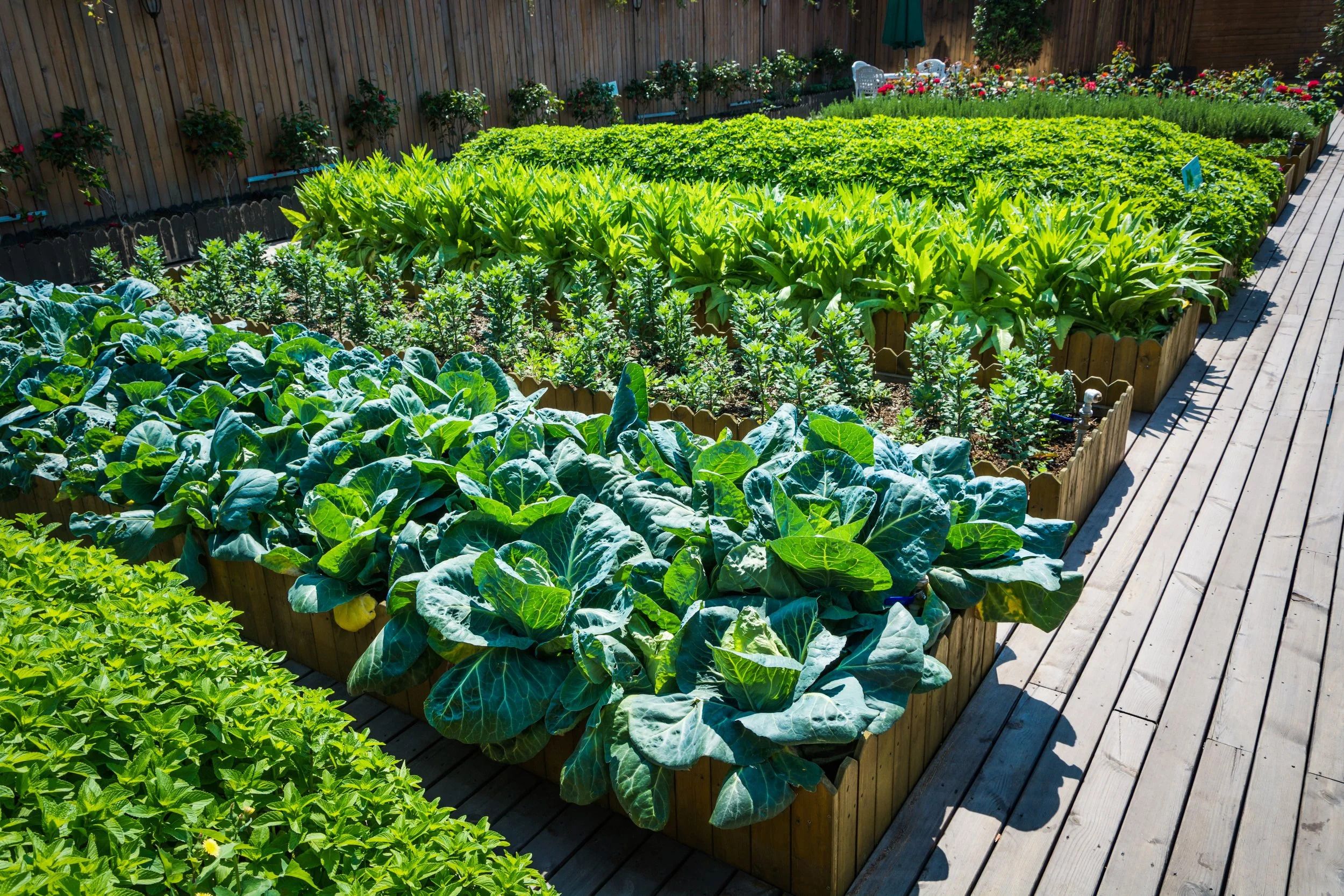
Growing food on an urban site introduces a design constraint that ornamental landscape does not have: the produce gets eaten. That changes what matters about the soil, about the water, about the materials used to build the beds, and about the surfaces surrounding the growing area.
An ornamental planting on a former industrial site can sit in soil with elevated lead and pose no meaningful risk. A vegetable bed in the same soil is a different proposition, because the exposure pathways include ingestion of soil adhering to root crops, uptake into plant tissue, and incidental ingestion by people, particularly children, working the beds.
This post covers what soil assessment on an urban growing site actually needs to establish, when raised beds are the right answer and how to build them so they work, what rooftop food production demands structurally, and the irrigation water quality question that gets asked far less often than it should.
1. Urban Soil Assessment
The starting point is that urban soil is not agricultural soil that happens to be in a city. It is a constructed profile of fill, demolition debris, and disturbed material, layered by a site history that usually is not documented.
What to test for
Lead is the dominant concern on most urban sites and comes from two ubiquitous historical sources: exterior lead paint weathering off buildings, which concentrates it in the soil within a few feet of any structure built before the late 1970s, and leaded gasoline deposition, which concentrates it near roads.
The consequence is a predictable spatial pattern. Soil at the drip line of an old building and soil within about 30 feet of a busy road are the highest-risk locations on a typical urban lot, and the middle of a large open area is usually the lowest. A sampling plan that averages across the whole site can mask a hot spot at the building perimeter that is where someone will want to put a bed.
Beyond lead, the test suite depends on site history. Arsenic where treated timber was used or where the site was orchard land. Petroleum hydrocarbons where vehicles were stored, serviced, or fuelled. Polycyclic aromatic hydrocarbons from combustion, asphalt, and coal ash, which are widespread in older urban soils. Cadmium, zinc, and other metals where specific industrial processes are in the site history.
Alongside contaminants, the agronomic tests matter: pH, organic matter, texture, cation exchange capacity, and nutrient status. Soil pH is particularly relevant because it affects metal availability to plants, with higher pH reducing the solubility and uptake of lead and several other metals.
Sampling that reflects use
Sampling is stratified by where growing will happen and by the contamination pattern the site history predicts. A composite sample from a proposed bed location tells you about that location. A composite from across the whole site tells you about an average that may not exist anywhere.
Depth matters too. Contamination from atmospheric deposition and paint weathering concentrates in the upper few inches, so a sample taken from 0 to 6 inches reflects the exposure zone for someone working the soil. A deeper sample may show much lower concentrations and give false reassurance.
Building drip line and roadside
The two locations where lead concentrates on a typical urban lot, from weathering exterior paint on pre-1978 structures and from historical leaded gasoline deposition. A site-averaged sample can mask a hot spot exactly where someone wants to put a bed.
2. Raised Beds and How They Fail
Where soil results indicate contamination above the level appropriate for food production, raised beds with imported media are the standard response. They work, provided the design actually separates the growing medium from the underlying soil.
The barrier
A raised bed built directly on contaminated ground without a barrier does not solve the problem. Roots grow down into the underlying soil, water moves between the layers, and worms and other soil fauna mix material across the interface over time.
The barrier is typically a geotextile, which prevents root penetration and physical mixing while allowing drainage, or in higher-risk situations an impermeable membrane, which prevents all exchange but then requires the bed to have its own drainage outlet. The choice depends on the contamination level and on whether the underlying soil is a source that could be drawn upward by capillary action in dry conditions.
Where an impermeable barrier is used, the bed becomes a container and has to be designed as one, with sufficient depth for the crop, a drainage layer, and an outlet that does not simply discharge onto the contaminated ground and mobilise it.
Depth
Bed depth follows from root zone requirements. Shallow-rooted crops such as lettuce and herbs manage in 6 to 8 inches. Most vegetables want 12 inches. Root crops, tomatoes, and anything with a substantial taproot want 18 to 24 inches. A bed built to 8 inches and planted with carrots produces poor crops and roots that reach the barrier.
Bed materials
The frame material is in contact with soil that will grow food, and some common choices are inappropriate. Timber treated with chromated copper arsenate, used widely before its residential phase-out, leaches arsenic and should not be used or reused for food beds. Recycled railway sleepers are treated with creosote and are similarly unsuitable. Reclaimed tyres leach a range of compounds.
Appropriate options are untreated durable timber species, which have a shorter service life and are accepted as a consumable, timber treated with a preservative approved for food contact applications, concrete or masonry, or galvanised or coated steel. Where a liner is used inside a timber frame, it serves both to protect the timber and to separate the media from it.
Growing media
Imported media has to be verified rather than assumed clean. Topsoil sourced from an unknown location can carry its own contamination, and compost from municipal green waste can contain persistent herbicide residues that damage sensitive crops for several seasons. Testing the source material before delivery is the practice, and it is regularly skipped.
A blend rather than straight topsoil generally performs better in a bed: topsoil for mineral content and cation exchange, compost for organic matter and nutrient release, and a coarse fraction for drainage. Straight compost holds too much water and shrinks substantially as it decomposes.
3. Rooftop Food Production
Rooftop growing operations divide into two structurally distinct types, and confusing them causes problems.
Container systems
Containers, raised beds, and grow bags placed on an existing roof impose concentrated loads at their bearing points. The structural questions are the same as for any rooftop equipment: what is the roof's reserve capacity, and how do the point loads distribute relative to the framing beneath?
The load itself is substantial. Saturated growing media weighs in the range of 90 to 110 pounds per cubic foot. A container 24 inches deep imposes roughly 180 to 220 psf over its footprint when saturated, which exceeds the design live load of most roofs not built for the purpose. Distributing containers over the framing lines rather than at mid-span, and limiting depth to what the structure allows, are the design responses.
Water has to be accounted for at full saturation, not at typical moisture content, because that is the condition after irrigation or after a storm. And drainage from the containers has to reach the roof drains without ponding, which means the container feet must not obstruct the flow path.
Built-in rooftop farms
A purpose-built rooftop farm distributes media across the roof surface as an intensive green roof system, with the structure designed for it from the start. Design loads of 150 to 250 psf are typical depending on media depth, and the structure is proportioned accordingly.
The waterproofing and root barrier requirements are those of any intensive green roof, covered in more detail in our post on green roof systems, with the addition that a growing operation involves regular foot traffic, tools, and periodic media replacement, all of which impose wear that an ornamental green roof does not experience. Protection layers above the waterproofing have to account for it.
Access, egress and code
A roof used for growing is occupied space and triggers the requirements that go with it: guards at the perimeter meeting height and loading requirements, an accessible route where required, egress capacity for the occupant load, and where produce is handled or sold, potentially food facility requirements.
Getting media, tools, and harvest on and off the roof requires a route. Where there is no service elevator reaching the roof, everything moves by stair, which limits the operation's practical scale more than any other single factor.
Wind on a Rooftop Growing Operation
Roofs experience higher wind speeds than ground level, and rooftop growing operations put lightweight, high-drag objects into that environment. Grow bags, row covers, hoop tunnels, shade cloth, and empty containers all become projectiles at wind speeds well below the design event. Anything not heavy enough to stay put needs to be positively anchored, and the anchorage has to transfer into the structure rather than relying on ballast that itself can move. This is a routine source of damage and a real hazard on tall buildings.
4. Irrigation Water Quality
Water applied to food crops is a direct exposure pathway, and the source determines what the risks are.
Potable supply. Meets drinking water standards and is the default for food production. The engineering requirement is backflow prevention: an irrigation system connected to the potable supply requires a backflow preventer of the type appropriate to the hazard, because fertiliser injection or submerged outlets create a cross-connection risk. Where fertigation is used, a reduced pressure zone assembly is generally required rather than a lesser device.
Harvested rainwater. Attractive and widely used, but roof runoff carries whatever is on the roof: bird droppings, atmospheric deposition, and material leaching from the roof surface. Asphalt shingle and some coated metal roofs contribute compounds that are not appropriate for food crops. A first-flush diverter discarding the initial runoff removes much of the accumulated surface material, and filtration and storage design determine microbial quality. Applying harvested rainwater by drip to the root zone rather than by overhead spray onto edible foliage substantially reduces the exposure.
Greywater. Where permitted, greywater from showers and laundry can irrigate landscape, but application to food crops is restricted in most jurisdictions and generally prohibited for crops eaten raw. Where it is used, subsurface application is the requirement, and detergent and salt content affect the soil over time.
Groundwater or surface water. On a site with a well or adjacent surface water, testing for the contaminants the site history suggests is necessary before use on food crops. Shallow wells on urban sites are particularly susceptible to whatever is in the surrounding soil.
5. Surrounding Surfaces and Deposition
A growing area does not exist in isolation from what surrounds it. Dust and runoff from adjacent surfaces reach the beds.
Where a bed sits adjacent to bare contaminated soil, wind transports that soil onto the growing surface and rain splashes it onto foliage. Stabilising the surrounding surface, with paving, mulch, or established vegetation, prevents this. A raised bed surrounded by bare ground carrying the contamination the bed was built to avoid does not fully achieve its purpose.
Roadside sites receive deposition from traffic, and a vegetative or built barrier between the road and the growing area reduces it. Distance helps, and where distance is not available a hedge or fence intercepts a meaningful fraction of the deposition.
Runoff from adjacent paved areas can carry contaminants into beds. Grading so that surface water flows away from rather than through growing areas is a straightforward design measure that is frequently overlooked because the drainage design was developed for the site rather than for the growing operation.
6. Practices That Reduce Exposure
Beyond the physical design, several practices reduce exposure and are worth building into the site design because they depend on it.
Mulching the soil surface reduces dust generation and reduces splash of soil onto foliage during irrigation and rainfall. It also moderates soil moisture, so it earns its place agronomically as well.
Providing a hand washing station at the growing area addresses incidental ingestion, which is a significant pathway particularly for children. This requires a water supply and drainage at the site, which is a design item rather than an operational one.
Crop selection matters where residual soil concern exists. Fruiting crops such as tomatoes, peppers, beans, and squash accumulate very little metal in the edible portion. Leafy greens accumulate more and are harder to wash free of soil particles. Root crops carry the highest risk both from uptake and from adhering soil. Where soil concern exists but is not high enough to require full replacement, siting fruiting crops in-ground and root crops in raised beds is a rational allocation.
Conclusion
Urban food production changes what matters about the site because the produce is eaten. Soil assessment has to be stratified to the growing locations and to the depth someone will work in, and it has to test for what the site history predicts rather than a generic suite. Where results indicate a problem, raised beds work if the barrier actually separates the media from the ground and if the frame materials do not themselves contaminate the soil.
Rooftop production is a structural problem first: saturated media weighs enough that most roofs not designed for it cannot carry a meaningful depth, and rooftop wind turns lightweight growing infrastructure into a hazard. And irrigation water quality is a pathway that gets far less attention than soil does, particularly where harvested rainwater is used on crops eaten raw.
